|
By Susan Yanos “Call me Ishmael.” So begins Herman Melville’s gargantuan epic of the great white whale, Moby Dick. Now don’t worry, I’m not recommending the novel for your summer reading list, but as I have been thinking about the personal story and the spiritual journey, Melville’s narrator has been haunting my dreams—until I realized that it was reading this novel that first got me interested in why we tell stories. I am a spiritual director, but I am also a writer and writing teacher. Over the years I have watched numerous students struggle to write the stories of their lives—in memoirs and non-fiction essays, or fictionalized in short stories and novels, in poetry, and in spiritual autobiographies. What I have seen over and over again is the power of story writing to reshape how people think about themselves and their world, about God and faith. Story theologians have said that stories serve three very important functions: world building, truth seeking, and self healing. In fact, some of my more astute students have noticed that writing is indeed spiritual work, and it was this that led me into spiritual direction. Now as a writing teacher, I have all kinds of suggestions which help writers go through this process, but it has taken some time and struggle to figure out how to be with spiritual directees when they bless me with the stories of their lives. It has taken even longer to figure out how to be with myself as I tell my own story, and often I am not a very good companion! Fortunately, Melville’s narrator whispers through my dreams. Call me Ishmael, he says, and we know immediately that this is not his given name but the name he chooses to give, perhaps just for this audience, just for this telling of the tale—and many readers of the novel get the impression that this is not the only time Ishmael has told his story, that indeed he has told it many times, may perhaps tell it many times more to any audience who will listen, whether willingly or not. He’s driven to repeat it, trying to understand why he alone survived while the rest of the crew died—many of whom he deems to be much better men than he. You’ll remember that in the Bible, the oceans are representative of the great forces of chaos which God did not destroy but bound within their basins. Deep within them dwells the monster of chaos, Leviathan, sometimes described as many-headed or as a crocodile or—pertinent to our Moby Dick tale—as a whale. Often storytelling is the ship we sail over the watery chaos of our lives. We tell our lives’ stories to protect us from the turbulence which threatens to pull us under, or when we do go under, to somehow find meaning in the struggle, in the confusion and fear, in the suffering and pain. Like Ishmael, we tell the same stories over and over again. Perhaps you have witnessed this in family members who have undergone some trial and cannot let it go, or in yourself. Henri Nouwen, in his book The Inner Voice of Love, writes, “There are two ways of telling your story. One is to tell it compulsively and urgently, to keep returning to it because you see your present suffering as the result of your past experiences.” Nouwen wrote this book during an intense emotional and spiritual crisis. By studying his own urges and compulsions, his own desire to tell his story, he came to see that there is another way, a way to tell your story “from the place where it no longer dominates you,” where the compulsion to tell it is gone. Such an approach requires distance, as well as the vision to see the telling as the way to freedom, and the wisdom to know that the past does not need to control the present. Nouwen wrote that then the past “has lost its weight and can be remembered as God’s way of making you more compassionate and understanding towards others.” 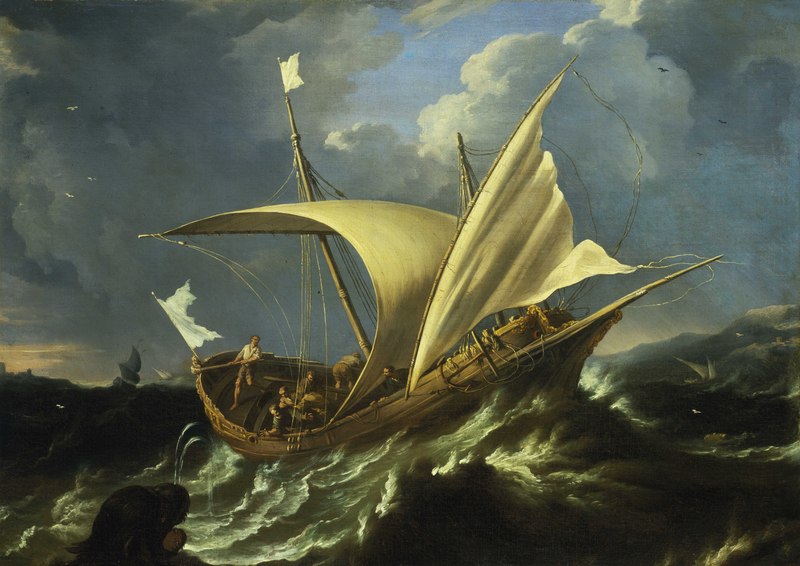 'Jonah and the Whale', Carlo Antonio Tavella (1668–1738), Public domain, via Wikimedia Commons So this telling and retelling are important, are necessary, because although we cannot change the relentless reality of the plot, we can change the role we choose to play. We can move from the victim of the story of our lives’ events to its survivor, to its hero. (I’m not suggesting that this is the ideal trajectory for our personal stories, but it gives an idea of the change that is possible.) Some argue that this change is so mind-altering that it is, in fact, a re-writing of our personal histories. I prefer the term re-visioning to re-writing. We see order where before there had been nothing but chaos, meaning where there had been only perplexity, a glimmer of beauty in the ugliness oppressing us, light in the shrouding and suffocating darkness. This all takes time—much time—and much patience as we go through the many retellings. And it takes a sensitive ear to pick out the subtle shifts in the story and bring them to our notice, along with a gentle reminder that God did not destroy the waters of chaos. Therefore, God is in the darkness as well as the light, in the ugliness and perplexity as well as in the beauty and meaning. God is in our hunger as well as in the loaves and fish that feed us. Ultimately, this is not an intellectual task, but a heart task. All this has led me to two questions I struggle with personally. First, how best to help directees—and myself—see God’s presence in all aspects of our lives, especially in the watery depths where Moby Dick smashed Ishmael? All too often we don’t feel that Presence. I trust that God will reveal in God’s own time, because I know that too often we are not ready to receive a direct assurance from others. We have first to experience fully what appears as God’s absence. But having said that, is there nothing I can do to help? Second, what about those times when we get stuck in the telling, when we get lost in our own stories by becoming so absorbed with ourselves that we fail to see the larger themes of the story unfold? I want to know how we move from a compulsive storytelling—because locked in the past—to becoming open, aware, receptive, and trusting of the spiritual process, even to the “stuckness” itself, as well as to the grace within the telling, to any movement away from letting the past dominate the story, to God’s presence amidst God’s seeming absence. For me, one key is to remember that just as Moses feared that he would be destroyed if he looked upon God’s face, begging God to show him just the behind, we too can often be destroyed by a too direct look at truth, especially the unpleasant truths about ourselves—or at least be so overwhelmed by them as to be unable to take them in. Such is the case for Melville’s narrator. Unable to take in the truth, he walks all around it by cataloguing every inch and pound of a whale in tedious chapters that most readers skip because, they complain, those chapters cause as much misery for them as the ship’s crew endured in its battle with the whale. The narrator thinks that he can eventually comprehend the mystery that is Moby Dick, as well as Captain Ahab’s need to conquer it, by studying mere facts. I think that’s what happens in a lot of storytelling I hear from folks—this almost compulsive need to record every detail. But that’s approaching it with the intellect. Remember that getting beyond story compulsions is heart work. To engage the heart, we can tap into the imagination. Stories are so powerful because they combine the language of reason (declarative sentences, facts and explanation) with the language of the imagination (dreams, fantasies, the subconscious). Psychology has revealed that the imagination carries truth, but perhaps more important, the imagination allows us to hold contradictory elements in tension. Consequently, the language of the imagination can lead us more deeply into ourselves, becoming ways to face indirectly truths we are unwilling or unable to face directly. Such language carries deep insights which we cannot verbalize. Many years ago, I discovered that students writing memoir instinctively chose images that resonated with them, but they didn’t know why and frequently didn’t even realize they’d done so. My job was to pay attention and then call their attention to the images. For instance, a young woman brought to workshop several short vignettes, including a story about her childhood cancer and another about how she thought a ghost lived in her childhood home. She believed nothing connected the pieces and wanted to throw most of them out and start over. I encouraged her not to, and eventually she began to see that her life was haunted by more than one specter. The largest specter was fear—the fear to dream of the future because her cancer might not remain in remission. Bringing that ghost into the light not only made for a good memoir, but it seemed to destroy the past’s power over her present. The ghost still inhabits the house—an appropriate metaphor for the self—but she found it is a pretty large house. Or there was the student who wrote about a tornado that swept through her town, which she later saw as part of a pattern of imagery centered around destruction, revealing the dysfunction in a family marred by abuse. Or the student who came to understand her bungee jumping as a metaphor for the uncertainty of her life because she was born with a hole in her heart. These stories stunned the students’ classmates with their profound beauty, a beauty which resulted because the storytellers were willing to sit with the chaotic jumble of fragments they had generated until they could see links between them. The stories became a way for them to tell their truths indirectly, to let the images and the structure reveal deep insights which they could not, and probably still cannot, verbalize directly. By the way, these students were not extraordinarily gifted writers, nor did they have years of training as writers. Therefore, one strategy we can adopt is to note the images which appear in our storytelling, explore them further, and be willing to sit with the resulting chaos. Researchers have noticed that the distinguishing characteristic between a good and a poor writer is the ability to tolerate chaos. Neither writer likes it, but while the good writer endures the tension, the poor writer will grasp at the first idea that comes along simply to be rid of the unease. The same, I think, is true of the spiritual journey. Any time we can engage the imagination, there’s the potential for mess and chaos, but also the potential to bump the story out of the rut it’s stuck in. Another strategy I’ve stumbled upon is to re-write the ending. If I don’t like how I responded to someone, I re-write it. I challenge myself not to stop with merely changing what I said, but to go further and see the experience as a scene with consequences: what will happen next and next and then after that? What if you hadn’t received that wound, been scarred in just that way? Re-write the story so that everything leading up to the injury stays the same, but the injury doesn’t happen. Don’t stop there, because I suspect you’ve already done this step. Go on with the story. Imagine the consequences. When Melville’s narrator demands that we call him Ishmael, we suddenly realize that he is telling his truth, although indirectly, by linking with another Ishmael, the first-born son of Abraham, first born but not the true heir, not the favored son, not the better son. A slave yet more than a slave, he and his mother, Hagar, are driven into the desert alone, exiled, abandoned, condemned to wander far from home—a fate the novel’s narrator feels he shares. So a third strategy I’ve learned is to connect my personal story with one of the great stories of literature, because when I am able to do so, interesting connections are forged through the imagination. Biblical stories and ancient myths are particularly powerful vehicles for this, one reason being they rarely provide the psychological insights or emotional filler that we’ve come to expect from more contemporary storytellers, thus leaving important gaps which we must fill. I’ve been reading the story of the Gerasene demoniac in Mark’s gospel lately, and noticed that even though he begged Jesus to allow him to come along on the journey with the disciples, Jesus told him to go back home, back to the very people who chained him in that graveyard as if he were already dead. What was that like, I wonder. Did his family and neighbors marvel at the miracle and praise God, or did they watch him warily, unwilling to get close emotionally, never trusting him because it would surely be just a matter of time before he snapped and once again hurt them. People don’t really change, you know, I can hear them say behind closed doors. Such gaps in the plot and in the characters’ emotions force us to imagine what is missing, and it is this opening that allows us to examine our own situations within theirs. Think of the implications of this for the self-awareness that is necessary to understand our lives. After Nouwen wrote The Inner Voice of Love while undergoing six months of spiritual and emotional care, he wrote what I consider his most beautiful book, Return of the Prodigal Son, where he explores his own past by immersing in the parable, in Rembrandt’s painting of the parable, and in Rembrandt’s life. Counting his own biography, he imaginatively mined, compared, and wove together four stories. Let me give you a personal example. Unfortunately, I had a falling out with some family members. It was a difficult time, very difficult. Now this is going to sound really geeky, but then I am a literature geek: one morning I woke up with Odysseus’ black ship in my head. I began to see my situation as a scene from the Odyssey. The scene I had in mind was when Odysseus had to sail between a rock and a hard place. Rather than take a much longer but safer route, he chose rather arrogantly to navigate between the deadly whirlpool named Charybdis and the rocky lair of the many-headed monster, Scylla. As you’ll recall, he doesn’t make it. Scylla’s heads lunge down and eat some of his crew, his ship gets sucked into Charybdis’ mighty maw and is destroyed, the crew drowned. So I imagined Scylla’s heads bearing the faces of my family members and began to draw in my sketch book a very bleak scene. My ship was going down, caught in the whirlpool of my anger. I wasn’t going to make it either. Then I remembered the rest of the story. Odysseus nearly drowns, but he does not die. Instead, his clothes are ripped from his body by the currents and he’s swept upon the shores of a beautiful island, naked as a newborn or as a newly baptized neophyte, younger looking and more handsome than before. I know, I want to get ahold of some of those sea salts for my beauty regimen, too. On the island, he is offered a new life with a new and younger wife, a new kingdom to rule, and years of peace without conflict and the suffering conflict engenders. But that is not who he is. He says thanks but no thanks, and returns to his true wife, Penelope, and much conflict and suffering as he reclaims his own kingdom from those who tried to replace him while he was gone. In the far corner of my drawing, I drew myself washed up on a beach. Identifying my story with Odysseus’ story helped me get unstuck from the details of my experience and express what I had not been able to before. Yet knowing the whole story challenged me to see that I had choices before me. I was not a victim assaulted by invincible monsters or trapped in the watery depths. And because I understood why Odysseus chose to go home, even though he risked life to do it, I became more aware of the options before me and what I needed, what I wanted to do in this situation. Call me Ishmael. Call me Odysseus. Call me Ophelia or Jack the Giant Killer, Ruth or Naomi. Some have defined humans as creatures who think in stories. Others have said the basis of ministry is not to serve others but to enter into their stories. We could explain the Incarnation as God entering the story of humanity. Once we enter a story, nothing is ever the same. Susan Yanos is the author of The Tongue Has No Bone, a book of poems, and Woman, You Are Free: A Spirituality for Women in Luke; and is co-editor and co-author of Emerging from the Vineyard: Essays by Lay Ecclesial Ministers. Her poems, essays and articles have appeared in several journals. A former professor of writing, literature and ministry of writing, she now serves as a spiritual director, retreat leader and freelance editor. She lives with her husband on their farm in east-central Indiana (US), where she creates art quilts and tends to her hens, fruit trees and gardens.
Susan's other work on Foreshadow: God Who Sent the Dove Sends the Hawk (Poetry, January 2021) Love Song of the Anawim (Poetry, April 2021)
0 Comments
Doreen Nyamwija shares lessons learned through working at the Iona Centres, Scotland One of the practical things that attracted me to work here, after my time as a volunteer, was seeing people with normally big or important roles working alongside people with less important roles. For example, after seeing Sharon, the Deputy Director, and the rest of the team (whom she oversaw) washing the dishes together, I was humbled. To me, this was a symbol of discipleship, being servants to one another. We need more leaders than bosses in this world. Things may not always be as good as they should be on Iona, but this kind of “discipleship leadership” is still demonstrated in lots of different ways here. I pray and hope it spreads. During the season, I tell volunteers that I am their line manager but I am always open to new ideas. Knocking down the building and rebuilding it in a day might be wishful thinking, but ideas that are within our means and practical, we can consider. People often come up with good ideas to improve something that irritates them. For example, one of the volunteers hated the fact that the kitchen in the MacLeod Centre got very congested when everyone was trying to set up the tables for meals; he hated people coming one by one to wash their hands in the kitchen. So, I asked him what his solution would be. He suggested installing a sink in the common room, which would reduce the congestion in the kitchen. Later I told my line manager, who took it further, and now this has been done and does make a big difference. People often think that the sink has always been there or wonder how this could not have been pointed out before. Doreen Nyamwija holds a business degree in entrepreneurship and for four years worked as the head housekeeper for the MacLeod Centre on the Isle of Iona, Scotland. She has established a charity providing accessible toilets for schools across Uganda, and she is currently working to build an accessible bed and breakfast for locals and visitors in Uganda, where she lives with her husband and their two children. To find out more about her B&B project and how to support it, visit the website here or email her at Nyamwijadoreen@gmail.com.
This piece is an excerpt from Doreen's book Never Give Up: My Life Story from Uganda to Iona (Cloister House Press, 2017). By Tim Harvey One of the occupational hazards of pastoral ministry is that people occasionally try to trap you on controversial issues. To be fair, sometimes people trust you and simply want to learn more. But not always. So when Bill (not his real name) said, “Are you really OK injecting aborted baby parts into your arm?” I knew that even though we would continue talking, our conversation had effectively ended. My biggest challenge in that moment was managing my own response. While I disagree with Bill’s opinion on Covid-19 vaccines, what frustrated me the most was his opinion of me. As I measured my own declining credibility in his facial expression and tone of voice, I could feel my own fight or flight response rising. How would I respond? It is tempting to view someone like Bill as a right-wing conspiracy theorist to be mocked or cancelled for the views he’s come to hold. But such a response misses the point. Bill is not a bad guy; he’s quite talented, runs a successful small business, and enjoys staying up to date on the issues of the day. He can speak in depth on any number of topics, political and otherwise. What makes conversations like these difficult is that Bill gets his news from one place on the political spectrum. He has constructed an echo chamber that not only confirms what he already suspects, it also tells him how he should interpret differing viewpoints. Because the trusted voices in his echo chamber tell him that the mainstream media is both fundamentally dishonest and dangerous to our country, any attempt of mine to offer a differing view of the Moderna and Pfizer vaccines—no matter how carefully researched—becomes not a counterpoint to be discussed but a heresy to be defeated. People who think differently than he become enemies. The thing is, on a certain level I understand where Bill is coming from. Christian theology teaches us that we are “aliens and strangers” in this world. One doesn’t need to live on the theological or political right to understand that praying “your kingdom come…on earth as it is in heaven” means that the kingdoms we see aren’t the ones we’re hoping for. Humans, regardless of our spiritual or political beliefs, are ultra-social animals whose need to be a valued member of our tribe is more important than being right. Each of us—not just the Bills of the world—belong to a tribe that offers value and meaning to our lives. But membership in a tribe comes with great pressure to conform to the values of the tribe. This pressure to conform makes it difficult to hear, let alone engage with, contrary viewpoints. Whether we ascribe this to millions of years of evolutionary development or to our fallen sin nature, leaving one tribe for another requires nothing less miraculous than Christian conversion. So how can I respond? I can mourn. I can mourn what might be the loss of a friendship I’ve come to value, one where I had assumed those feelings were mutual. I can mourn the fact that someone I admire on so many levels no longer seems to admire me nor respect my opinion. I can mourn the fact that being members of the same congregation does not mean we belong to the same tribe. In the Beatitudes, Jesus tells us, “Blessed are those who mourn.” As a pastor, I’ve learned a thing or two about mourning. I’ve heard doctors say to families, “we did all we could.” I’ve sat with a family when the funeral director closed the casket for the last time. Mourning comes with the territory. But I never considered I’d one day mourn the loss of respect and trust from a friend whose political perspective convinced him that I am not to be taken seriously. My mourning makes it difficult to hear the second half of Jesus’ beatitude: “for they will be comforted.” Honestly, I think it would be easier to lash out at Bill—or at least forward him a few articles. It would lessen the weight of the cross I’m bearing these days. For now, my main task is to accept that Bill and I live in different echo chambers. A different set of voices shapes my world. I need to find the comfort that comes to those who mourn before I do anything else. Tim Harvey has served as pastor of Oak Grove Church of the Brethren in Roanoke, Virginia, since 2015. He and his wife Lynette have been married for 28 years and have three young adult children and one son-in-law. Tim has written extensively for various Church of the Brethren publications, including magazine articles, worship resources, Bible Study and other devotional materials. When he is not in his office, Tim enjoys woodworking and half-marathon running. By Urzula Glienecke On a hill in the city of Edinburgh stands a beautiful, historic church: the Greyfriars Kirk. Just down the hill is its seemingly humbler sister: the Grassmarket Community Project. Humble it might be, but it holds a golden heart. A friend was recently complaining about his 'wayward' son. He said he wondered about taking him 'somewhere like the Grassmarket Project', to 'show him where things could end up'. That stopped me in my tracks. To see the Project as a deterrent example! In fact it is exactly the opposite: the people we do not expect to 'enter the kingdom of God' are those in whom God is present and acting – the very foretaste of the kingdom of God. Yes, many people who come to the Project have addiction issues. Some have had a brush with the law sometime in their lives. Others live with long-term illness or recover after a stroke. Many are foreigners in the country. Many struggle with mental health problems, many are poor and live on benefits. But it is one of the most wonderful places I have experienced. People care for and about each other and their environment. Nobody is judged for what they cannot do. Everybody is supported and welcome. People find belonging after long isolation. People learn new skills that they can use in work life or just do things for fun. People come together to eat, to celebrate and to become a community. Last year we prepared a play comprised of each person telling a story. One man had received a job interview at last, but unfortunately it was at the same time as his hostel's mandatory health check. Because he was not present during the health check, he lost the room and landed on the streets again – and that at Christmas time! But his story ended in kindness: he was welcomed into people's homes. This year we planted a fruit orchard in the Kirkyard, including the Peace Tree, planted with the Sikh community. Recently, a group of six from the Project went to Zambia to help to build a school for girls in a remote, rural area. They did sleep-outs and other fundraising and gathered the money for the trip themselves. Some had never been outside Scotland, some had never been outside Edinburgh. Some struggled with addictions, some with mental health issues. But they did it! And it changed their lives. They had thought they were poor and disadvantaged. Now they saw that having running water is a privilege, that they had so much – enough to live well. But best of all, they saw that they can do something and be cherished and welcomed by people, be wanted and be equal. Urzula Glienecke, PhD, is a Latvian theologian, artist and activist living in Scotland. Urzula is a Member of the Iona Community. She is passionate about social justice, the environment and empowering people at the grassroots level. For more info about the Grassmarket Community Project, visit their website here.
This piece was first published in The Adventure Is Beginning (Wild Goose Publishing) and has been republished here with the author's permission. By Sam Seligman Years ago, I lived in New York City, where I'd share my songs on Monday evenings in Greenwich Village folk clubs. Mondays were open mic nights, when amateurs signed up to perform. Nights in the summer were the busiest, when tourists and visitors from the suburbs ventured into the bohemian community to shop, eat, and visit the clubs. One summer Monday, I had started a new job, selling ice cream cookie sandwiches on the streets, so I didn’t think I’d be able to get to the Folk City club in time for their 7 p.m. signups. But two fellow church members, Suzanne and Diane, who also performed, volunteered to sign me up. When I returned to the Village from work, they told me they’d drawn a good number for me: I’d be singing between 8:30 and 9 p.m. “We’ve been praying for you all day,” they added. “We asked the Lord to place angels beside each table (where the audience would be sitting).” Before leaving Suzanne and her husband’s tiny flat on MacDougal Street, we joined in prayer, surrendering the evening to God. Entering Folk City, I could feel it buzzing with energy. The three of us walked past the bar area, heading for the main room. We grabbed a table, sat down, and waited. Musicians took the stage, performed, and departed. Heeding the numbers called, I prepared for my turn. Then, unexpectedly, the emcee introduced a “special guest” who emerged from the audience to a loud applause. I’d never heard of the guy, but from the crowd’s reaction, I figured he was a local favorite or a celebrity. After finishing his opening song, he shared a personal story. “I just hitch-hiked from San Francisco. Most of the cars that picked me up had their radios turned onto a Gospel station. They’re all talking about Jesus. “I wish someone would write an anti-Jesus song,” he half-jested before stopping himself. But it was too late. The audience jumped on his suggestion. Voices raised, they appeared to be pushing him to write one on the spot. The musician had committed himself, so he went ahead. Something must’ve taken over the guy; his impromptu lyrics were hitting on all cylinders. He was spewing out his share of derision, culminating with the words, “Stay on the cross, Jesus, we don’t need you.” The audience roared its approval. I was incensed. “They think Christians walk around in white shoes, drinking milk," I thought. "I’ll give them something different.” My mind flipped through a song list, thinking of lyrics about judgment. Then, out of nowhere, I remembered the words I'd heard at a neighborhood park during a church picnic. The pastor had given a brief sermon, from which this question returned to me: “In everything you do, are you doing it to glorify the Lord, or glorify yourself?” Clearly, an internal conversation was taking place. “You know I want to glorify you,” I sighed in my thoughts. “What do you want me to sing?” The impression of one song resonated. It was about the Holy City, described in the biblical book of Revelation. I didn't know the song's name, but I’d learned it at a church in Colorado on a hitch-hiking journey. I'd been singing it a lot of late, twice in three weeks at Folk City. I also thought of fresher material. Yet, I couldn’t shake that song about the Holy City. “They don’t want to hear this,” I reasoned. “Besides, the ‘Holy City’ song is gentle. How could I follow this guy on stage with that?” “It’s your choice. But you asked me what I think you should sing.” Turning to Suzanne, I asked, “What do you think I oughta sing?” “How about that song from Revelation?” was her immediate response. Well, that settled it. Moments later, the musician finished his song and left the stage to a drunken applause. Without missing a beat, the emcee introduced me. “And now, here’s someone from the other side: Sam.” Talk about a set-up. But I’d made my decision, and I was focused. When I got behind the microphone, I sat on a stool, which I rarely did, as I preferred standing. I kept my guitar pick in my denim pockets, choosing to strum with my fingers instead. I started my set with a short tune I’d never shared before. “Well how are you today? Have you got some things on your mind? “Have you lost your way? Is it hard to keep it inside? “Well, you can have your friends Give you all their advice. “And they will tell you again What is wrong, and what is right. “But only you will know. And then again, you may not.” I stopped, placed my guitar on my lap, and looked out toward the audience. I couldn’t see their faces, but the club was full and I could sense they were listening. I didn’t have a speech planned. I simply spoke and the words flowed out. “You know,” I began, “there’s a lot of musicians seated here. We’ve been given a gift, and we can use our music to heal or to hurt others. And many of us have the gift of words. We can use our words to lead people to the truth or (looking in the direction of the musician who’d left the room) lead others to ignorance. “There’s a book I read, and I’m sure you know which one. I’m not here to preach. I just want to share a few words from that book.” And then I began singing that tune I’d learned in Colorado: “I saw the Holy City, the new Jerusalem, coming down out of Heaven from God.” I don’t know who composed the song, but I added my own ending to it, also based on the hopeful promises at the end of Revelation. “He will wipe away every tear from your eyes And there will be no crying and no pain “Yes, He will wipe every tear from your sight When you are made new again. “And He who sits upon the throne says, 'Behold, I make all things new'…” As I was singing, I began looking down on a young man dressed in denim, wearing sandals, playing a guitar. I was astonished: that was me! For a moment, I saw my mouth open and close. Words must've tumbled out, though I didn’t hear them. The song reaches these final words: “He gives water without price From the fountain of life “When you conquer you shall have all these things. “For you will be his child As He is now my Lord: Behold the King of kings.” When the song ended, the place erupted with applause. I thought, “Their souls are responding. This has nothing to do with me.” If there was any acknowledgment in my direction, it was simply to say "Thanks. We needed that." Sam Seligman is a writer-folksinger. He is writing a memoir on his road experiences.
By Kelcey Ellis How deep the Father’s love for us How vast beyond all measure That He would give His only Son To make a wretch His treasure.[1] There are many reasons I chose this song as my children’s lullaby. The song I sing over them as they get drowsy. When they wake up scared in the middle of the night. What I hum in their ear as we slow dance together in the middle of the living room. In addition to the overarching theme of a deep love I pray they will one day come to know, one of the big reasons is that it’s not all sunshine and smiles. Because neither is this life we live. We recently became foster parents to a 'little bug' that puts our household at #2under3. Parenting is tough. Parenting when you are not legally the parent is even more tough. Fostering is not for the faint of heart, friends. It brings out such a complexity of emotions that I struggle to know how to respond when people ask how it’s going. We are filled with love for this precious bundle of life that brings such joy to such uncertain times. We are hopeful our son has a sibling, however long that is, to learn how to share and love and be with. We are exhausted with middle-of-the-night feedings, naps that won’t be had, toddler tantrums trying to understand why another person came out of nowhere to take away our attention. We are angry at the system that has little bug, just six months this side of the womb in the second foster home, fifth overworked social worker, navigating Women, Infants, and Children (WIC) benefits and monthly social worker visits and doctor’s visits and cardiologist appointments and bi-weekly infant massage appointments and... Parent visits make this even more complicated. My heart breaks as another mom, across the screen from me, wipes away tears as she smiles at her child that rests in my arms. As she asks, “Do you think my baby knows who I am?” Tears flow as I put a picture of this precious babe in an ornament that says “Baby’s first Christmas” and stash it in the backpack to travel onward with him, treasuring our matching family pajamas and smiles under the Christmas tree. The cruelty of our situation is that I get to daily squish those cheeks and rub those little toes, and all she can do is watch through a screen. The cry in my heart over the brokenness that existed for mom and little bug to be separated echoes across the brokenness of humanity that existed for the Father to send His Son to the cross. “Searing loss,” another phrase from my children's lullaby, is a vividly accurate description. We didn’t celebrate the day little bug came into our home. No baby shower or fanfare. Just a mama and a dada with hearts overflowing for someone so small that has already gone through so much trauma. We don’t know what the future will hold for little bug and mom. The brokenness that brought little bug to us may keep him with us for a long time. Mom may go through all the steps she needs to bring little bug back into her arms for good. Or we may get the privilege of being his forever family someday. But the one thing we do know is that we love little bug with all that we are and, as long as he is with us, he is home. For those who worry that we will get too attached: yes, we already are. And yes, the grief will be overwhelming when or if little bug leaves our home. We love little bug fiercely and want what is going to be best for him, whether that means staying with his biological parents or going to a blood relative or folding him into our forever family. And with the example of a Father who demonstrated His love for us by placing His Son with adoptive parents so that we could be adopted into His family, what other response do we have? A wise man whose father recently unexpectedly died shared these words that resonate with my heart right now as I process the loss that was, the loss that is, and the loss that is yet to come: “What we love in those who are dear to us is a divine gift, too, and so it is right and good for us to love the Creator through loving those for whom we care and those we have lost. And in this sense, without erasing or ignoring the loss, our love comes to rest in the One who cannot be lost.”[2] Oh for us to find our rest in the deep, deep love of the One who cannot be lost. -- [1] Copyright © 2021, Thankyou Music, songs@integritymusic.com. Used by permission. [2] Words by Tim Gaines, inspired by St Augustine. Kelcey Ellis works in education as a Program Director supporting individuals with executive functioning skill needs. She holds a Bachelor's degree in Family Life Studies, a Masters of Public Health and a Mild/Moderate Education Specialist credential. She, her husband, their two-year-old and foster kids live in San Diego, California.
Dean Nelson on removing distractions to encounter divine love Almost every morning since I’ve been working from home these past few months, I watch my neighbors argue. I open my garage door, set up my stationary bike in the driveway, pedal hard for about 30 minutes and observe the drama. It’s amazing how that tiny bird can dive-bomb the much bigger and noisier crow. They squawk and chirp at each other as they shoot straight up in the air, straight down, the crow making evasive maneuvers that the pilots at the nearby Miramar air station can only dream about. When the big crow finally flies to a nearby pine tree, the little bird flies back to the top of a palm tree, just a few feet away. The two still face each other and argue from their respective perches. Classic schoolyard taunting, only in different octaves. Something about each other’s mothers, no doubt, with maybe an occasional “… and the horse you rode in on!” Then the crow glides toward the palm tree and the aerial battle picks up again. Eventually the crow gives up and flies away, squawking something like “You haven’t seen the last of me!” The little bird returns to the top of his tree, where presumably there is a nest to protect, and remains silent and attentive. I’m thinking that this is what the quarantine has been like. Some of my writer friends feel that it’s really no different from the way they typically live, hunkered down in front of their computers or notepads, reading, researching, typing. They’re used to isolation. But most of us aren’t. And if there is a silver lining in this pandemic cloud, it is that many of us have been forced to confront what it means to be by ourselves without the usual distractions. In 1654, the scientist and philosopher Blaise Pascal wrote, “All of humanity’s problems stem from man’s inability to sit quietly in a room alone.” There is even some research at the University of Virginia to back that up.[1] I would augment that to include our inability to take a walk in our neighborhood without looking down at our phones. Why is it so hard to live without distractions? What are we left with when we don’t have them? We just have ourselves. Which may be a good thing. Or not. Even in quarantine there are still some distractions worth chasing away. Like that crow across the street, they are taunting us, and even trying to invade our personal space, demanding our attention. Not all of them deserve our constant consideration, though. As a journalist and a journalism professor, it pains me to tell my friends to stop having a constant flow of news into their homes. Keep informed, I tell them, but do it in small bites. Much of what is posing for news is repetitive at best, and speculative and incorrect at worst. Dial it back and turn it off for a while, I tell them. And social media feeds aren’t really feeding you. They could be poisoning you. Just sit with yourself a bit, I tell them. There are some good discoveries to be made there. As the German philosopher Arthur Schopenhauer said, “It is difficult to find happiness within oneself, but it is impossible to find it anywhere else.” But that crow of distraction is relentless. Several years ago two friends and I trekked and camped in Tibet. The first few days I suffered from altitude sickness — we were at 17,000 feet — that rendered me useless for any adventures. But if you’re going to be forced into contemplation, Tibet is the place to be. I could sit in my hostel room and listen to the bells and the chants from the nearby temple, and inhale the incense from down the hall. My head pounded as if a railroad spike had been driven into it, but I sat and listened and breathed. It was excruciating. Sometimes I sat in a temple, lit only with the heavily scented yak-waxed candles. One evening I sat at the edge of a lake where Tibetan Buddhist monks are said to have seen visions. I began to get used to sitting quietly because it was all I could physically do, and eventually the throbbing in my skull began to wane. My friends and I went to a village velcroed onto a mountain slope, and decided to split up for the day. We didn’t set a time to reconnect. We just said we’d get back together somehow, somewhere, eventually. I hiked along the edge of a river that was moving with such ferocity that it easily turned a prayer wheel the size of a grain silo built into its banks. I gazed at the prayer wheel and river for a very long time, feeling the knot in my brain slowly loosen. I had a book and a journal in my backpack, but for some reason I didn’t take them out. A gray, long-haired horse wandered over and stood next to me. We looked at one another for what felt like several minutes. Neither one of us had anywhere we had to be, so we just remained there. I gave him part of my granola bar. Eventually, I closed my eyes and just listened to the river and the breathing of the horse. I could feel my mind race at first (how long was I going to sit here? How will I find my friends again? What is the next school year going to be like? Am I hungry? How does my head feel? Are my legs falling asleep?), but then it gradually slowed down to … nothing. I began thinking of the people I loved. My wife, my son, my daughter, and tears began flowing from my eyes. Not sobs. They were like the river — plentiful and steady, coming from a deep, deep place in a mountain that had developed an opening. And one word kept coming to me. Gratitude, gratitude, gratitude. The Persian poet Rumi wrote, “Observe the wonders as they occur around you. Don’t claim them. Feel the artistry moving through, and be silent.” That day in Tibet I observed and felt the silence, and was overwhelmed by the love that filled in. I wonder if this is what Jesus was getting at when he said, “The Kingdom of God is within you.” The Christian missionary E. Stanley Jones wrote this in the 1940s, but he could have been writing about it now, as our cities are boiling over and our authorities ignore the real issues that have caused the eruptions: “The outer arrangements of men are awry because the inner arrangements of men are awry. For the whole of the outer arrangements of life rests upon the inner. Men cannot get along with each other because they can’t get along with themselves.” Seems like we’re battling a virus from the outside and a virus from the inside. This morning I went out to my driveway and started riding my exercise bike, ready to watch the avian battle across the street. But today, there was no crow. The small bird sat at the top of the palm tree. Nothing was happening. Except the bird was singing. -- [1] 'A new study found people are terrible sitting alone with their thoughts' Dean Nelson is the founder and director of the journalism programme at Point Loma Nazarene University. His most recent book is Talk to Me: How to Ask Better Questions, Get Better Answers and Interview Anyone like a Pro (2019).
'Finding Healing in Lockdown' was first published in The San Diego Union-Tribune. |
Categories
All
ForecastSupport Us
Archives
May 2024
|
 RSS Feed